
a short excerpt from
Myst: the Book of ATrus

“Where are we?” Atrus asked,
looking about him at the cave into which they had “linked,” his eyes taking a moment to adjust to the darkness.
Gehn edged past him. Standing on tiptoe, he reached into a narrow recess high up at the back of the cave. “This is one of my more recent worlds,” he answered, removing a slender box. Within was the Linking Book that would get them back to D’ni. Quickly checking that it had not been tampered with, he slid it back into the hole in the rock, then turned, looking to Atrus. “This is my Thirty-seventh Age.”
“Ah …” Atrus said, if only because he could think of nothing else. Personally, he would have spent a little time and effort thinking of a name for the Age—something mystical and romantic, perhaps—but Gehn was pragmatic when it came to his creations.
For three years now he had been accompanying his father to these Ages, and never once had Gehn thought to give an Age a name. Numbers. It was always numbers with his father.
At the front of the cave, a narrow tunnel curved away to the left, sloping steadily upward. Fastening his cloak at the neck, Atrus followed Gehn out, wondering what kind of world this was.
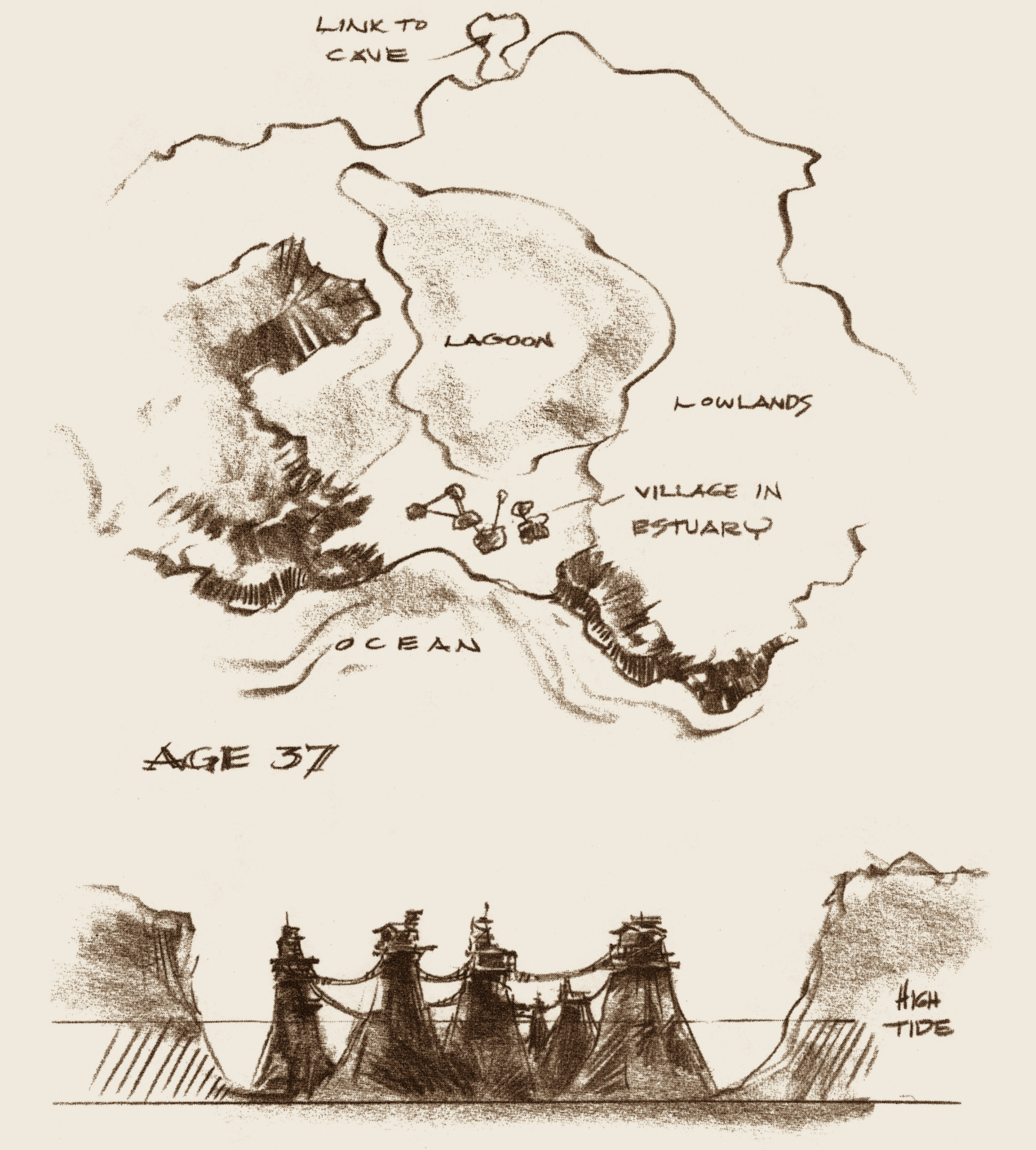
Up above it was night. They emerged into a rough circle of open grass surrounded on three sides by the bare rock of the hillside. Below them, under a dark, blue-black sky in which sat two small moons—one white, one red—lay an island. At the center of the island was an oval lake.
Atrus stood there, taking in the sight, impressed by the circle of low hills that formed a natural bowl about the lake. The lake itself was dark and still, reflecting the twin moons, the surrounding sea shimmeringly bright.
Looking at it, Atrus began to question it, as he always did, wondering what words, what phrases his father had used to get that soft, sculpted shape to the hills? Or was that a product of the underlying rock? Was it limestone? Or clay, perhaps? And those trees, over to the right— were they a natural variant, or had Gehn written them in specifically?
The air was sweet and cool, rich with the varied scents of living things.
“It’s very beautiful,” he said finally, looking to his father, but Gehn merely grunted, surveying his work with what seemed a haughty disregard.
“I have done much better work than this,” he answered, climbing up onto one of the rocks, then stepping down the other side. “In some ways this is my least successful experiment. I tried to keep it simple. Too simple, possibly.”
Atrus climbed up onto the rock, hurrying to catch up. He had seen quite a few of his father’s Ages these past three years—he hadn’t begun to try making Ages himself yet—but it had never ceased to astonish him that mere words could create such vivid and tangible realities.
There was a path leading down between the scattered rocks. After a dozen paces it opened out onto a bare slope covered in thigh-high grass. Below them, maybe a mile or so distant, huddled around the left-hand side of the lake, was a scatter of low, rectangular buildings, oddly shaped, as if half made of stone; maybe forty in all, lit by the lamps which hung over doorways and on poles along the harbor’s edge. Suspended walkways linked the huts. Beneath the eaves of the nearest huts a number of dark, upright figures could be glimpsed.
Atrus turned to stare at Gehn, surprised. “It’s inhabited?”
“Yes, but don’t expect too much, Atrus. The people of this Age are an immensely simple folk. Crude, one might almost say. They manage to eke out a meager existence by way of fishing and basic agriculture, but as for culture, well…”
Gehn’s laugh was dismissive. Even so, Atrus felt a strange excitement at the thought of meeting them. Though Gehn had occasionally brought in working parties from one or other of his Ages, he had never taken Atrus to an inhabited Age. Not before today.
They walked on, descending the thickly grassed slope. At first Atrus thought they would come upon the islanders unobserved, but then, a hundred yards or so from the edge of the village, a shout went up. Someone had spotted them. At once there was a buzz of voices down below and signs of sudden, frantic activity.
Gehn touched his arm, motioning that he should stop. Atrus glanced at his father, alarmed. “Are we in danger?”
Gehn shook his head. “Be patient, Atrus. You are here to observe, so observe.”
Atrus fell silent, watching as a dozen or so of the tall, manlike figures came up the slope toward them, carrying flaming torches.
Ten paces from them, the party stopped, dropping to their knees and bowing their heads, abasing themselves before Gehn. One of their number—the tallest of them—stood, then, coming forward, his head bowed, held out a garland of yellow flowers, offering at the same time a few words of broken D’ni.
“You are welcome, Great Master. Your dwelling is prepared.”
In the flickering light of the torches, Atrus saw what he was wearing. It was a crude, handwoven copy of a Guild cloak!
“Good,” Gehn said, lowering his head so that the man could place the garland over it. Then, straightening up, he gestured to the man, “Gather the villagers. I shall speak to them at once.”
“Master!” the acolyte answered, glancing at Atrus, his dark eyes curious.
“Now lead on!” Gehn said, his voice stern, commanding.
They went down, through a narrow lane flanked by low but spacious huts with steeply sloping roofs of thatch, their wooden walls rising out of a bed of large, shaped boulders. Suspended, slatted wooden walkways swayed gently overhead as they walked through, and as they came out beside the lake, Atrus saw how the earth there had been covered with boards; how steps had been cut into the face of the rock, leading down. Below was a kind of harbor, one wall of which had been created by sinking hundreds of long poles into the bottom of the lake to form a sunken barrier.
In the harbor were a dozen or so small but sturdy-looking fishing boats, their masts laid flat, their cloth sails furled.
People were gathering from all over now—men, women, and children. They were pale-skinned, stocky, clearly human in their dark-brown smocks. Their hair was uniformly light in color and spiky, reminding Atrus of straw.
Farther along, a channel had been cut through the rock, linking the lake to the open sea. It was not very broad— barely wide enough for a single boat to navigate—but a strong wooden bridge had been thrown across it.
On the other side, the land began to climb again, and on the top of a narrow ridge, behind which was the more massive slope of the hill, was what looked like a meeting hut of some kind, much larger than the huts that faced the harbor. As they crossed the bridge and began to climb the slope, Atrus saw lights being hastily lit up ahead, garlands hung between the wooden posts at the front of the building.
Behind them, the people of the village gathered, following silently, their torches burning brightly in the moonlit darkness.
Coming to the front of the building, Gehn turned, facing the crowd, whose number had grown to several hundred.
“People of the Thirty-seventh Age,” he began, speaking loudly, the circle of hills making his words echo back to him across the lake. “This is my son, Atrus. I have decided that we shall stay with you for a time. While he is here you will treat him with the same respect you accord me.”
Atrus stared at his father, surprised. This was the first he had heard of any of this. But Gehn spoke on, his voice booming now.
“Whatever he wants, you will give to him. Whatever he asks, you will do. Is it understood?”
“It is understood,” two hundred voices answered as one.
“Good!” Gehn said, then raised his left hand imperiously, dismissing them. He turned to Atrus.
“Come, Atrus. Inside.”